The Pulse Score is a dynamic metric that quantifies a member’s engagement and commitment to your company.
It is one of the two key metrics of the Conquest Pulse.
Understanding its role, calculation method, and interpretation within the tool is essential to gaining a clear view of your community’s dynamics
What is the Pulse Score?
The Pulse Score is an engagement metric that reflects all activities a member has done over the past 90 days.
It consolidates activities from both your community (reactions, replies, messages) and external platforms like LinkedIn, GitHub, webinars, based on the integrations you’ve connected to Conquest.
Tracking engagement beyond the community provides a more accurate view of a member’s engagement - not just within your community, but also with your company.
Calculation
The Pulse Score is calculated based on all activities listed in Activity Type and is recalculated every hour to provide the most accurate engagement data. Find out more about Activity Type.
It represents the sum of a member’s activities over the last 90 days, multiplied by the score assigned to each activity.
Formula :
Pulse Score = Sum of (Number of activities × Score per Activity Type)
Slack activity breakdown:
- 17 messages → 6 points each
- 4 replies → 5 points each
- 15 reactions → 1 point each
Total score:
(17×6)+(4×5)+(15×1)= 137 points
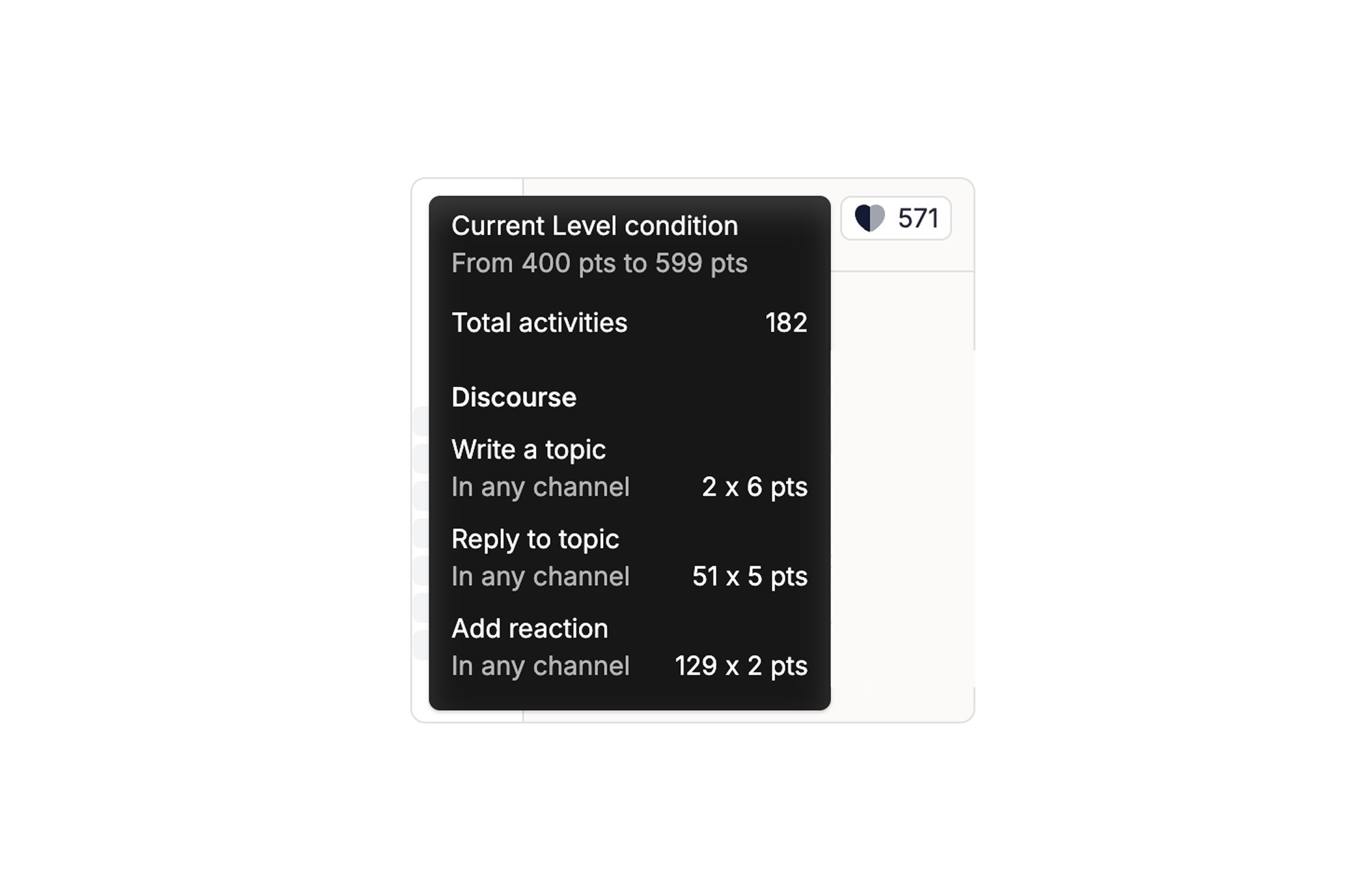
This tooltip shows a detailed breakdown of a member’s engagement score based on their activities.
- Current Level Condition: Score falls between two set thresholds.
- Total Activities: Number of recorded activities
- Points Breakdown:
- Each activity type (messages, replies, reactions, etc.) has a specific score.
- The score is calculated by multiplying activities by their assigned points.
The more integrations you have, the more activities will be recorded, and the higher the Pulse Score will be.
Timeframe
We have determined that 90 days is the most balanced timeframe for measuring a member’s engagement.
-
A 30- or 60-day window would be too restrictive, not providing enough perspective on a member’s long-term activity and making it harder for you to effectively manage your community.
-
A period beyond 90 days would dilute recent engagement, making it harder to identify active members and react in a timely manner.
This 90-day rolling window ensures that the Pulse Score reflect both consistent participation and recent activity, giving you the best insights to nurture and grow your community.
Associated Topics
Couldn’t find something? Contact us at support@useconquest.com
If you want us to suggest a new feature, drop a message on our Slack Community and we will review it.